



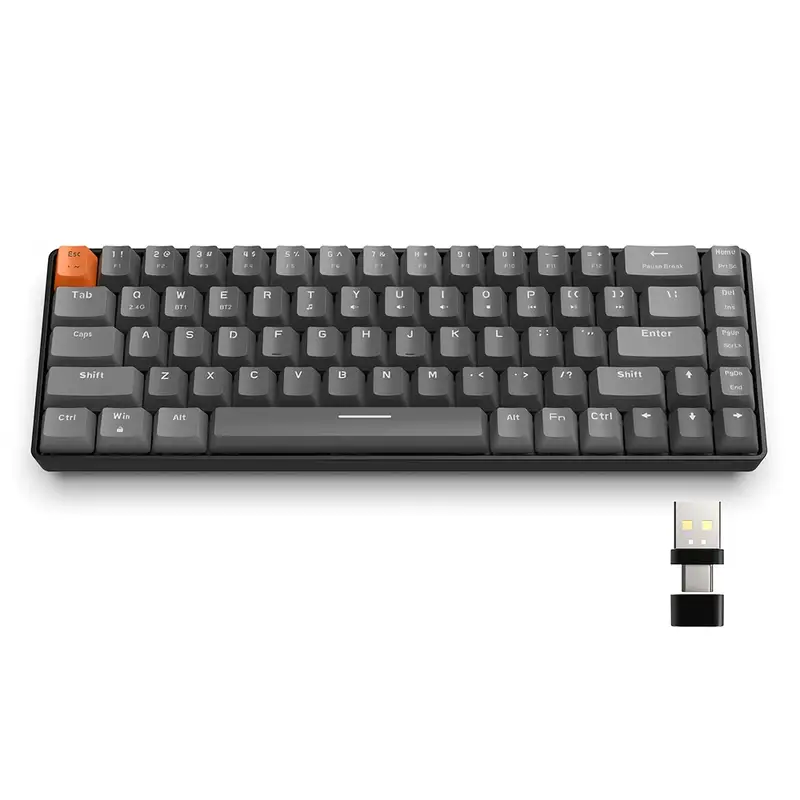
Typing efficiency is no longer just a preference—it’s a productivity advantage. Whether you’re working, coding, gaming, or writing, your keyboard plays a major role in how fast and accurately you can input text. In recent years, many users have discovered that How a wireless mechanical keyboard Improves Typing Speed and Accuracy is not just a marketing claim, but a real, measurable benefit in everyday use.
This article explores why mechanical switches, wireless technology, and modern keyboard design combine to enhance both speed and precision.
Understanding the Wireless Mechanical Keyboard Advantage
At its core, a mechanical keyboard uses individual switches under each key rather than a rubber membrane. This design gives each keystroke a more precise and tactile response. When paired with wireless connectivity, it creates a clean, flexible setup that reduces clutter and improves ergonomics.
One of the key reasons users switch is simple: How a Wireless Mechanical Keyboard Improves Typing Speed and Accuracy comes down to consistent feedback and reduced input delay. Modern wireless technologies like Bluetooth 5.0 and 2.4GHz connections have significantly reduced latency, making them nearly indistinguishable from wired keyboards for most users.
Faster Typing Through Tactile Feedback
Speed in typing is heavily influenced by how quickly your fingers can register a keypress without hesitation. Mechanical switches provide tactile or audible feedback that confirms actuation instantly.
This feedback loop helps users build rhythm and muscle memory. As a result, many typists find that How a Wireless Mechanical Keyboard Improves Typing Speed and Accuracy is closely tied to the physical sensation of each keystroke. When your brain doesn’t need to “guess” whether a key registered, typing naturally becomes faster.
Different switch types also influence speed:
- Linear switches offer smooth keystrokes for rapid input
- Tactile switches provide a bump for controlled typing
- Clicky switches offer audible confirmation for precision
Improved Accuracy Through Reduced Typing Errors
Accuracy is just as important as speed. A fast typist who makes frequent mistakes ultimately loses time. Mechanical keyboards reduce errors by offering more defined actuation points.
Unlike membrane keyboards, where keys can feel “mushy,” mechanical switches require deliberate presses. This helps prevent accidental keystrokes, especially during long typing sessions.
In fact, How a Wireless Mechanical Keyboard Improves Typing Speed and Accuracy is often most noticeable when users transition from laptop keyboards or older membrane models. The sharper key response leads to fewer typos and more confident typing.
Wireless Freedom Enhances Ergonomics and Focus
Cable clutter may seem like a small issue, but it can affect posture and desk organization. Wireless mechanical keyboards eliminate this limitation, allowing users to position their keyboard at the most comfortable angle.
Better ergonomics indirectly improve both speed and accuracy. When your hands, wrists, and shoulders are relaxed, fatigue decreases significantly. This leads to longer, more consistent typing sessions without performance drops.
Another overlooked benefit is mental clarity. A clean workspace reduces distractions, which supports the idea that How a Wireless Mechanical Keyboard Improves Typing Speed and Accuracy is not only about hardware—but also about environment and focus.
Low Latency Wireless Technology for Real-Time Response
One of the biggest concerns users once had with wireless keyboards was input delay. However, modern wireless mechanical keyboards have largely eliminated this issue.
With high-speed polling rates and optimized wireless protocols, keystrokes are transmitted almost instantly. For most users—including writers, programmers, and gamers—the difference between wired and wireless is negligible.
This technological advancement reinforces why How a Wireless Mechanical Keyboard Improves Typing Speed and Accuracy is increasingly accepted in professional environments where precision and timing matter.
Muscle Memory Development and Long-Term Performance
Consistency is key when building typing skill. Mechanical keyboards offer uniform key travel and actuation force across all keys, which helps develop strong muscle memory over time.
Once your fingers learn the exact feel of each key, typing becomes almost automatic. This is another major reason How a Wireless Mechanical Keyboard Improves Typing Speed and Accuracy becomes more noticeable the longer you use one.
Over weeks or months, users often report:
- Faster average words per minute (WPM)
- Fewer corrections and backspaces
- More consistent typing rhythm
Gaming, Coding, and Professional Use Cases
Wireless mechanical keyboards are not limited to writers or office users. They are widely used in gaming and software development as well.
Gamers benefit from fast actuation and responsive keys that improve reaction time. Programmers benefit from reduced fatigue and fewer syntax errors during long coding sessions. Writers and editors enjoy smoother long-form typing.
Across all these use cases, How a Wireless Mechanical Keyboard Improves Typing Speed and Accuracy is demonstrated through a combination of speed, precision, and comfort.
Potential Trade-Offs to Consider
While the benefits are strong, wireless mechanical keyboards are not perfect for everyone. Some models require regular charging, and premium versions can be more expensive than standard keyboards.
However, for most users, the productivity gains outweigh these limitations. Battery life in modern keyboards often lasts weeks or even months, making maintenance minimal.
Final Thoughts
The shift toward mechanical switches and wireless convenience is more than a trend—it’s a functional upgrade in how people interact with their devices. From improved tactile feedback to reduced latency and better ergonomics, the benefits are clear.
Ultimately, How a Wireless Mechanical Keyboard Improves Typing Speed and Accuracy comes down to a combination of physical feedback, wireless efficiency, and user comfort. When these elements work together, typing becomes faster, more accurate, and significantly more enjoyable.
